
Multi-Unit Franchise Brand Bidding Conflicts: When Corporate and Your Units Bid on the Same Terms
Multi-unit franchise brand bidding conflicts: what to do when corporate and your units bid on the same terms.
Key Takeaways
- When corporate and your local units bid the same brand terms into the same geos, you inflate your own CPCs and split credit for navigational demand the brand already earned.
- Start with Auction Insights and search-term reports to prove overlap before you negotiate—impression share stolen by “you” is the clearest waste signal.
- Write down who owns brand keywords, close variants, match types, and which geos each party may defend. Handshake rules fail the first time budgets tighten.
- You can usually reduce conflict with geo fencing, shared negatives, and separate budgets without violating the franchise agreement—if those tactics stay inside the brand’s written advertising rules.
- Escalate when corporate policy or account access blocks a clean split; absorb when the wasted dollars are smaller than the political cost of a fight.
- Measure wasted brand spend as excess CPC × overlapping impressions (or as branded CPA vs. a non-overlapped baseline), not as “brand is expensive so it must be wrong.”
Brand bidding conflicts show up as rising branded CPCs, messy attribution, and franchisees arguing with corporate about who “owns” navigational traffic. If you run several units and also see national brand ads in your ZIPs, you need a written split—not another round of “let’s both bid and see.”
This playbook is for multi-unit operators who control local Google Ads spend and keep colliding with corporate (or neighboring owners) on the same brand terms. Franchise agreements and co-op guides differ, so confirm what your brand allows before you change targeting or pause campaigns. Google Ads policies and auction behavior also change; treat the tactics below as operator practice, not a promise that any specific setup is always permitted.
What Corporate vs. Franchisee Brand Auction Conflict Looks Like
Corporate vs. franchisee brand conflict is when two (or more) accounts in the same system bid on the brand name, close variants, or branded + city terms into overlapping locations—so your own network raises the price of traffic it already earned. The SERP may still show one ad, but the auction price and the lead-routing mess are real.
Typical symptoms:
- Branded CPC climbs while non-brand stays flat.
- Auction Insights shows another account (often labeled as you/your brand) with overlapping impression share in your core ZIPs.
- Calls and forms land in a national queue while local crews sit idle—or the reverse.
- Co-op claims get rejected because local brand spend duplicated national coverage.
Since Google updated overlapping-ad rules, more than one ad for the same business can sometimes appear in different ad locations on a results page. That does not make internal brand competition a good idea. Two owners bidding the same navigational query still push price up and fragment learning.
How to Prove Overlap With Auction Insights and Search Terms
Prove overlap with Auction Insights on branded campaigns plus search-term reports that show exact brand queries, then map those impressions to the geos both parties target. Screenshots and date-stamped CSVs beat anecdotes in any corporate negotiation.
- Isolate a brand campaign or ad group with exact and phrase brand terms (and the close variants you actually care about).
- Pull Auction Insights for the overlapping ZIP/city set and note impression share, overlap rate, and position above rate against your own brand domains or known national account patterns.
- Export search terms for branded queries and flag any that also appear in corporate reporting if you have visibility—or ask brand for a parallel export for the same weeks.
- Compare conversion paths: same phone/email within 30 days credited twice is a credit problem, not a demand problem.
If you cannot see corporate’s account, ask for a standing brand-overlap report as a condition of continued local brand bidding. Without data, every argument becomes opinion.
Who Should Own Brand, Geo, and Match Types
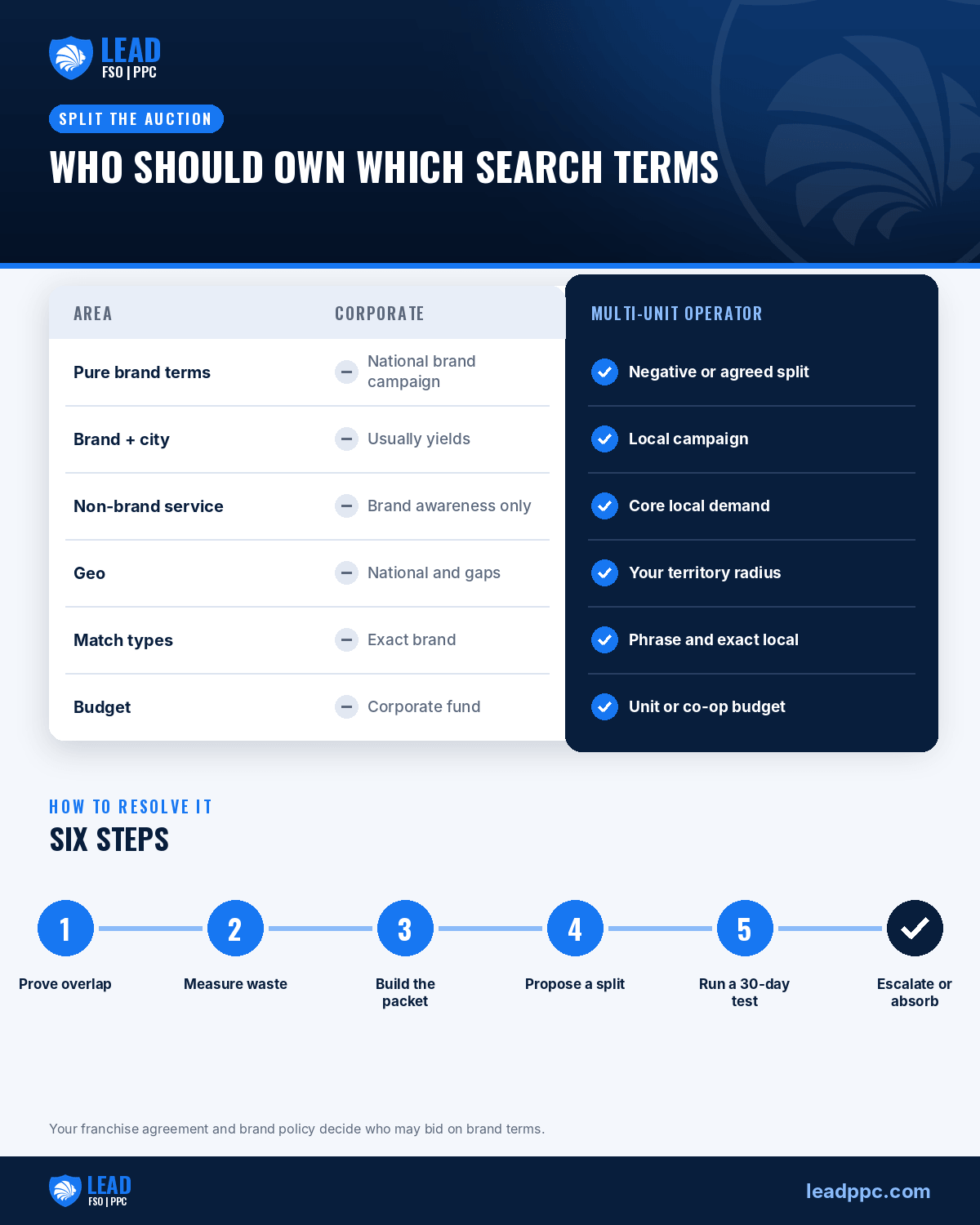
Someone must own the brand keyword set, the geos where brand may be defended, and which match types are allowed—ideally in a one-page addendum both sides sign. Leaving it to “common sense” is how multi-unit operators inherit silent auction wars.
A workable ownership model many systems use:
- Corporate owns core brand exact/phrase nationally (or by region) and routes leads by territory through the CRM.
- Local units own non-brand and local service terms inside their protected geos, with brand terms on a shared negative list.
- Branded + city / “near me” is either corporate-only or allowed locally only inside the unit’s core ZIPs with presence-only location targeting.
- Close variants and misspellings follow the same owner as the root brand term so nobody “accidentally” reopens the fight with a clever misspelling list.
If your agreement already assigns brand advertising to corporate, stop local brand bidding and focus spend where you control outcomes. If the agreement is silent, negotiate the split before the next budget cycle—not after CPCs spike.
Negotiation Checklist for Multi-Unit Operators
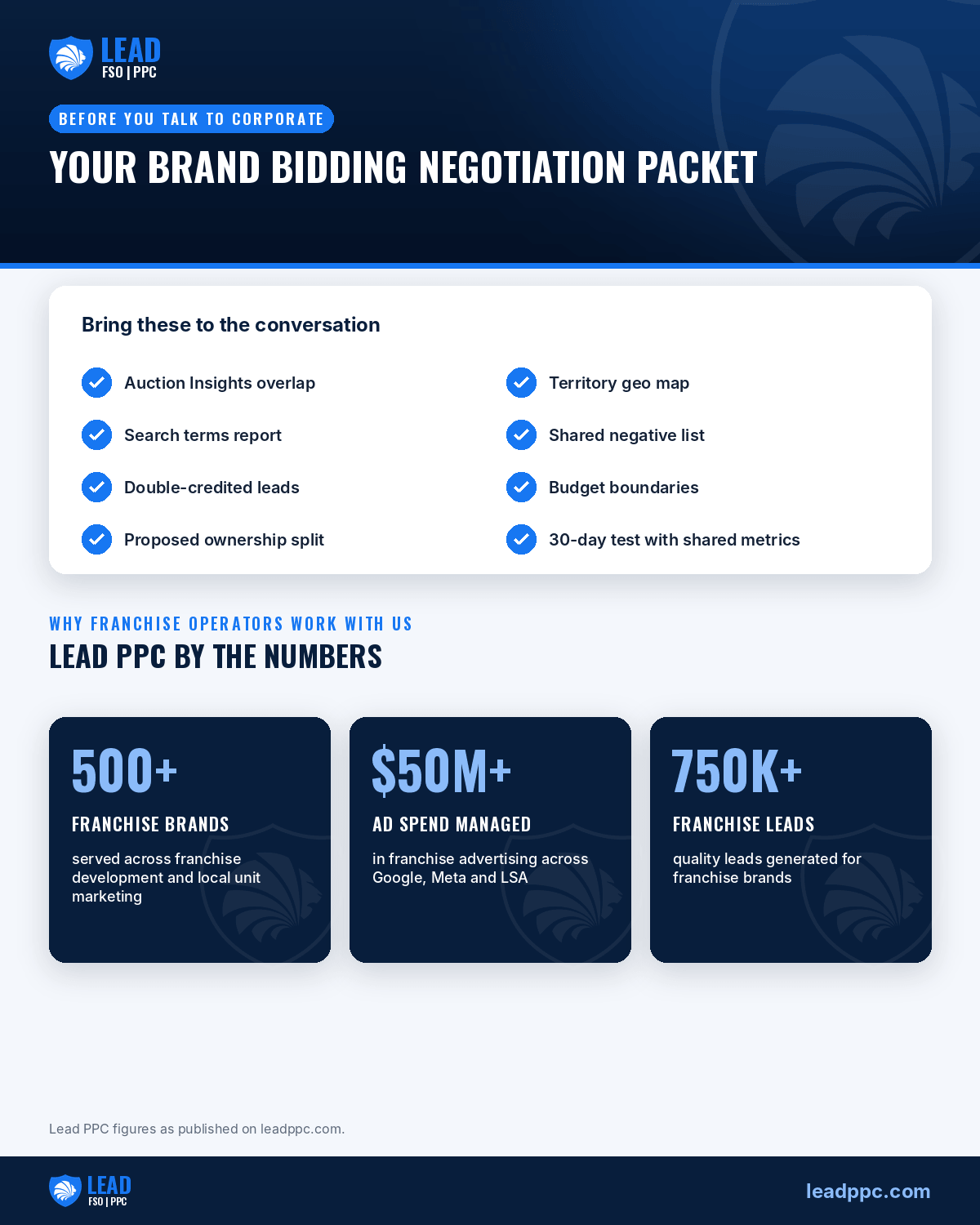
Negotiate with a short packet: proof of overlap, proposed ownership split, geo map, negative list, budget boundaries, and a 30-day test with shared metrics. Go in asking for a written rule, not a verbal “we’ll be careful.”
- Packet: Auction Insights, branded CPC trend, duplicate-lead examples, and estimated wasted spend.
- Ask: Who bids brand? Where? Which match types? Who owns close variants?
- Map: Exclusive core ZIPs per unit; seam rule for borders; presence-only location targeting.
- Lists: Shared negatives for brand terms in local non-brand campaigns (or the reverse if locals keep brand).
- Money: Separate budgets—no shared budget that lets brand steal from non-brand learning.
- Credit: One lead / one credit rule when national and local both touch the same household.
- Review: Quarterly check of Auction Insights so the conflict cannot quietly return.
For structure choices that make this easier to see and enforce, see our Google Ads account structure guide. For ZIP fencing between units you own, use the territory overlap playbook.
Geo, Negatives, and Budgets Without Violating the Agreement
Most brands will accept geo fencing, shared negatives, and per-campaign budgets that reduce internal competition—as long as you do not bid off-brand creative, leave your territory, or break co-op creative rules. Read the advertising addendum and co-op guide before you change anything corporate might audit.
- Geo: Target presence (people in or regularly in your locations), not “presence or interest,” when brand conflict is the issue. Exclude neighboring cores you do not serve.
- Negatives: Keep brand terms on a shared negative list in local non-brand campaigns if corporate owns brand. Keep competitor and job-seeker negatives shared either way.
- Budgets: Separate brand and non-brand budgets so Smart Bidding cannot drain service-term learning to chase cheap branded clicks—or the reverse.
- Co-op: If you claim reimbursement, document that local brand spend (if allowed) did not duplicate a national brand campaign your fund already pays for.
If corporate requires their MCC linked, that can help visibility—but linking alone does not stop overlap. Structure and written ownership do.
Escalate vs. Absorb: How to Decide
Escalate when overlap is material, measurable, and blocked by policy or access you cannot fix alone; absorb when the dollar waste is small relative to relationship cost or when a 30-day test already shows a clean path. Put the decision rule in writing so you do not re-argue it every quarter.
- Escalate if branded CPC is up sharply with high overlap rate, leads misroute, or co-op rejects local brand spend as duplicative.
- Absorb if overlap is occasional on seam ZIPs, volumes are tiny, or corporate already commits to a dated fix you can verify in Auction Insights.
- Hybrid: pause local brand for 30 days, measure non-brand and call volume, then decide with data instead of politics.
How to Measure Wasted Brand Spend
Measure waste as the premium you pay because an internal competitor is in the same auction—not as total brand spend. Brand traffic can still be valuable; the waste is the self-inflicted premium and the duplicated credit.
Practical approaches:
- Overlap premium: Compare branded CPC (or cost/conv) in high-overlap weeks vs. low-overlap weeks after a pause or geo fix.
- Impression-share method: Estimate spend on impressions where Auction Insights shows material overlap with your own brand, using average CPC for that segment.
- Credit cleanup: Count duplicate CRM records (same phone/email, national + local) and assign one owner; the second “conversion” is reporting fiction.
Report the number monthly next to unit-level non-brand CPA so leadership sees brand conflict as an operations cost, not a creative debate.
Frequently Asked Questions
Can my franchise units bid on the brand name if corporate already does?
Only if your franchise agreement and advertising rules allow it—and even then it is usually a bad default. Many systems reserve brand terms for corporate and route leads by territory. If locals may bid brand, limit it to each unit’s core geos with presence-only targeting and a written one-credit rule.
How do Auction Insights prove corporate and local brand conflict?
On branded campaigns, Auction Insights shows overlapping impression share and related metrics against other advertisers. When the overlapping domain is your own brand or a known national account pattern—and search terms confirm navigational queries—you have evidence of internal auction pressure, not just “the market got more competitive.”
Who should own brand keywords, geos, and match types?
Put ownership in writing. A common model: corporate owns core brand exact/phrase and close variants; local units own non-brand inside protected geos; branded + city is either corporate-only or local-only inside core ZIPs. Match-type rules should follow the same owner so variants do not reopen the fight.
Can geo fencing and shared negatives fix this without breaking the franchise agreement?
Often yes, if you stay inside brand creative, territory, and co-op rules. Presence-only location targeting, exclusions for neighboring cores, shared brand negatives on the non-owner’s campaigns, and separate brand/non-brand budgets reduce conflict without requiring a contract amendment—though a short written addendum still helps.
When should I escalate to corporate instead of absorbing the cost?
Escalate when overlap is material (CPC premium, misrouted leads, failed co-op claims) and you lack access or authority to fix it. Absorb when waste is small or a dated corporate fix is already in motion. Use a 30-day pause test when politics are hot and data is thin.
How do I calculate wasted spend from brand bidding overlap?
Compare branded CPC or cost/conversion in high-overlap vs. cleaned-up periods, or estimate spend on impressions with material internal overlap using Auction Insights and average CPC. Also deduct duplicate CRM credits so you do not treat double-counted leads as performance.
Need Help?
If you own several franchise units and brand auctions are colliding with corporate or neighboring owners—ownership splits, geo fencing, negatives, or measuring wasted branded spend—fill out our Contact Us form.

Entrepreneur with a focus on Lead Generation, Google Adwords, Bing Ads, and Conversion.

Leave A Comment