
Multi-Unit Franchise Ad Copy Compliance: RSAs That Pass Brand Review Without Killing CTR
Multi-unit franchise ad copy compliance: RSAs that pass brand review without killing CTR.
Key Takeaways
- Brand and legal usually flag unapproved claims, offers, trademarks, pricing, earnings-adjacent language, and location copy that implies rights you do not have—not “interesting headlines.”
- Build an approved asset library first, then assemble RSAs from that library. Pin only what must always appear, and pin 2–3 distinct compliant variants per pinned position so CTR is not stuck on one line.
- Put a review SLA in writing (who reviews, turnaround, what “approved” means). Waiting on informal Slack approvals is how launches miss opening weekends.
- Location-specific copy can coexist with national rules if city/ZIP lines stay factual, territory-true, and free of inventing rankings or guarantees corporate did not clear.
- Test under compliance by rotating approved variants—not by sneaking unapproved claims into “temporary” assets. Disapproved or paused assets should never re-enter via a different ad group name.
- When creative ownership changes mid-cycle (new agency, new unit, resale), freeze the approved library, re-map pins, and re-submit only what changed so you do not reset brand trust.
Responsive search ads fail franchise brand review for predictable reasons: a headline corporate never cleared, a local offer that conflicts with national pricing, or a pin that makes the only compliant line the weakest one. Multi-unit operators feel it hardest because every unit wants “our” angle while brand wants one voice.
This is the operator guide to RSA copy that clears brand and legal without sandbagging click-through rate. Your franchise agreement, brand book, and co-op creative rules still win any conflict with general PPC advice. Google’s RSA features (pins, campaign-level text assets, Ad Strength guidance, text disclaimers) change over time—confirm current behavior in Google Ads Help before you rebuild an account around a single tactic.
What Brand and Legal Usually Flag in RSA Assets
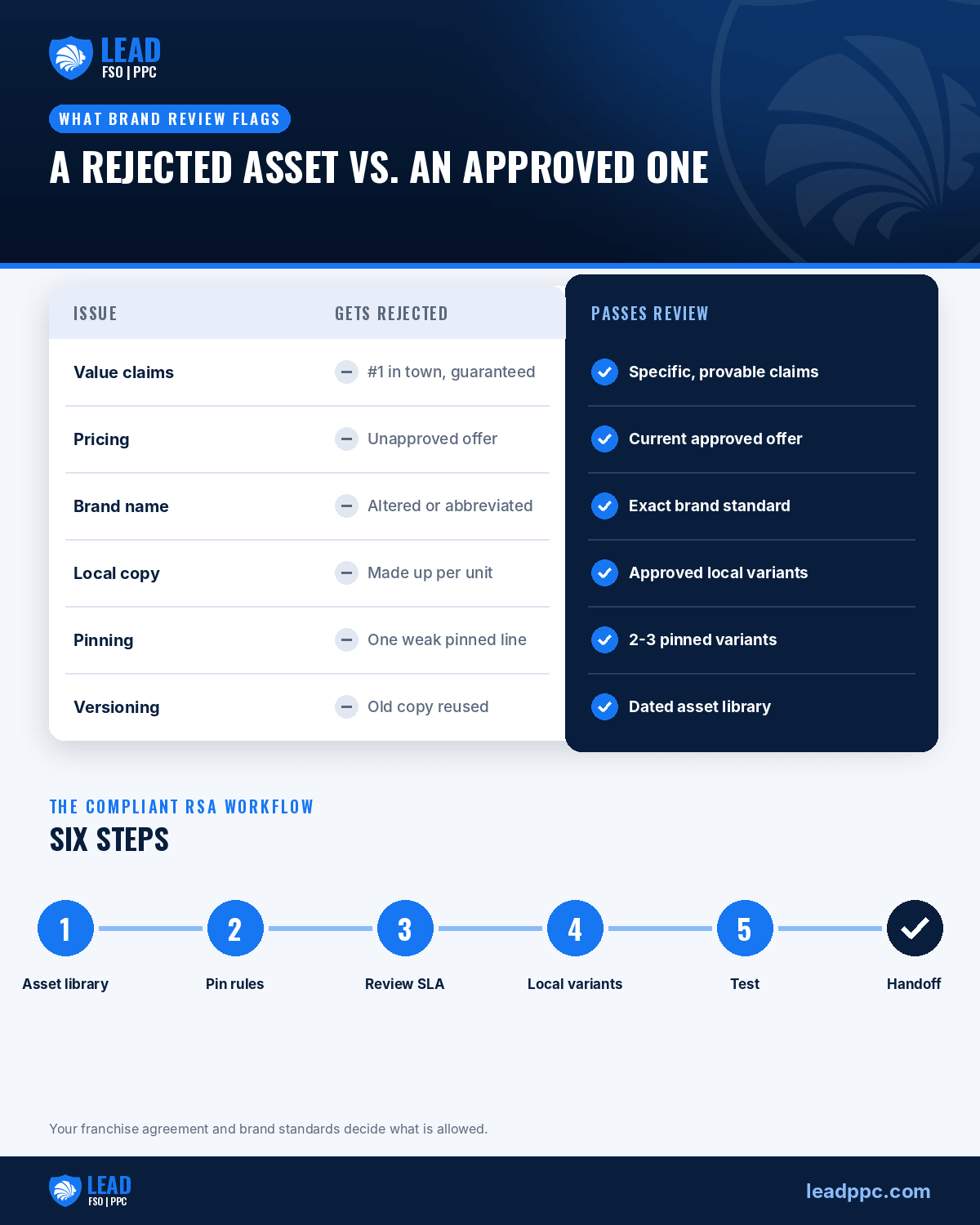
Brand and legal flag claims, offers, and trademark uses that are unapproved, misleading, or out of sync with the FDD / advertising rules—not merely “short headlines.” If an asset cannot stand alone in any combination, it should not be in the RSA.
Common rejection triggers for multi-unit Search ads:
- Unapproved value claims: “#1 in town,” “guaranteed results,” medical/financial outcomes, or anything that sounds like an earnings claim for the franchisee business.
- Offer and price drift: local discounts, financing teaser rates, or bundle language that national marketing did not clear for that market.
- Trademark misuse: altered logos in image assets, wrong legal entity names, or competitor-comparative headlines the brand forbids.
- Territory fiction: “serving all of [metro]” when your protected ZIP set is smaller, or implying corporate-owned coverage.
- Required disclosures missing: licensed-profession, franchise-opportunity, or offer terms that must appear when certain claims run.
Write every headline and description so it remains true and on-brand even if Google shows it next to any other approved asset. RSA combinations are not a place to hide weak compliance behind a strong pin.
Pin Strategy and the Approved Asset Library
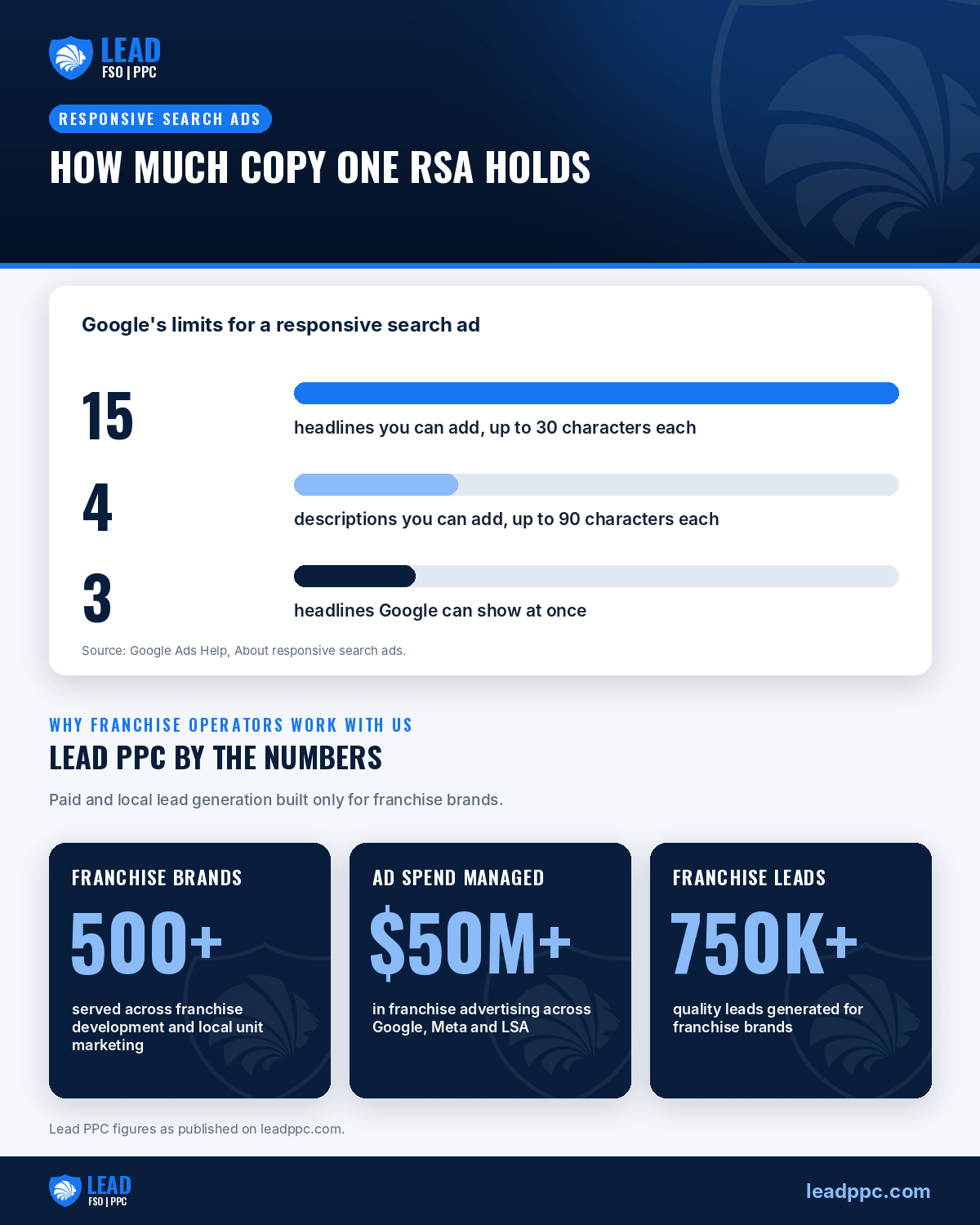
Create a shared library of pre-approved headlines and descriptions, then pin only the lines that must always show—ideally with multiple distinct compliant options per pinned slot. Pinning one weak mandatory line into Headline 1 is how compliant ads lose CTR.
Practical setup:
- Library first: 15+ approved headlines and 4 descriptions per theme (brand, offer, service, local proof), version-dated and stored where brand/legal can see them.
- Pin sparingly: Google’s own guidance is that pinning reduces combinations and can hurt Ad Strength. Use pins for legal/brand must-haves, not for personal preference.
- Pin multiples: If Headline 1 must be brand-safe identity, pin 2–3 unique approved identity lines to that position so the auction can still choose among compliant options.
- Campaign-level text assets: Where available, campaign-level headlines/descriptions can push required lines across every RSA—still subject to policy review—and should be managed as part of the same library, not a second shadow set.
- Disclaimers: When a disclosure must appear in Search ads, prefer Google’s text-disclaimer (or brand-mandated equivalent) over burying fine print in a description you hope gets chosen.
Keep unit-specific lines in a clearly labeled subset of the library so a Miami offer cannot accidentally publish on a Denver RSA.
Review SLA: Who Approves What, How Fast
A review SLA names the approver, the turnaround clock, the submission format, and what “approved” means for go-live. Without it, multi-unit launches stall on the same three headlines every month.
- Owner: brand marketing, franchise compliance, or a named co-op reviewer—not “whoever is free in Slack.”
- Clock: for example, 3 business days for library adds, 1 business day for swaps among already-approved lines.
- Packet: exact asset text, final URLs, geos, offer dates, and which units will run it.
- Decision: approved / approved with edits / rejected with reason code (claim, offer, trademark, territory, other).
- Expiry: seasonal offers auto-expire in the library so stale promos cannot be re-pinned later.
Agencies and in-house leads should not “soft launch” unapproved assets into low-budget ad groups. That pattern burns trust faster than a late submission.
Location-Specific Copy Under National Rules
Location-specific copy is allowed when it is factually true for that unit’s territory and still fits national voice, offer, and trademark rules. Local does not mean freelance brand.
Safe local patterns:
- City or neighborhood served that sits inside the unit’s approved geo.
- Hours, phone, and landing pages that match the GBP and call-tracking stack for that unit.
- Local proof that brand permits (review counts, years in market) without inventing rankings.
Unsafe local patterns:
- Metro-wide claims when you only cover a ZIP cluster.
- Unit-invented guarantees or price points that conflict with national menus or co-op rules.
- Headlines that imply the location is corporate-owned or the only location when it is not.
Mirror the same geo discipline you use in campaigns—see our territory overlap playbook—so copy and targeting tell the same story.
Testing RSAs Without Breaking Compliance
Test by rotating approved variants and measuring CTR/conversion within the compliant set—not by introducing unapproved claims as “experiments.” Compliance is a constraint on the test cell, not an excuse to skip learning.
- Hold pins constant when you test non-pinned headlines so you know what changed.
- Change one theme at a time (benefit vs. offer vs. local proof) inside the approved library.
- Retire losers back to “do not use” in the library rather than deleting history brand may need for audits.
- If Ad Strength complains about pinning, answer with more unique approved pins—not by unpinning a legally required line.
When a unit’s volume is too thin to learn, pool creative tests across similar units that share the same approved library and offer calendar, while keeping budgets and geos per unit.
Handoff Mid-Creative Cycle
When an agency, marketing lead, or unit owner changes while RSAs are live, freeze the approved library, document pins and final URLs, and re-submit only net-new copy. Mid-cycle chaos is a top source of accidental off-brand publishes.
- Export all RSA assets, pins, and policy statuses.
- Mark library rows as active / expired / rejected.
- Transfer brand portal or shared-drive ownership to a company login you control.
- Pause anything not on the approved list before the new team gets edit access.
- Schedule one brand re-review for assets the new team wants to add in the first 14 days.
Resale and multi-unit handoffs should include this creative packet beside account access—pair it with the 30-day marketing handoff checklist when a unit changes hands.
Frequently Asked Questions
What do franchise brand and legal teams usually reject in Google Ads RSAs?
Unapproved claims and offers, trademark misuse, pricing or financing language that was not cleared, territory claims that overreach the unit’s rights, and anything that sounds like a guaranteed outcome or earnings claim. If an asset is not safe in every combination, it does not belong in the RSA.
Should I pin brand-required headlines if pinning can hurt Ad Strength?
Yes when a line must appear for legal or brand reasons—pin it, and pin 2–3 distinct approved alternatives to the same position when possible. Google recommends pinning sparingly because it limits combinations; compliance pins are the exception, preference pins are not.
How fast should brand review RSA copy for multi-unit operators?
Set a written SLA. Many operators aim for a few business days on new library assets and faster turnaround for swaps among already-approved lines. The exact clock depends on your brand team; what matters is a named owner, a packet format, and reason codes for rejections.
Can location-specific RSA copy stay compliant with national brand rules?
Yes if local lines are factually true for the unit’s territory, match approved offers, and keep national voice and trademark rules. Local copy fails when it invents metro-wide coverage, rogue discounts, or ranking claims corporate did not approve.
How do you A/B test RSA headlines under strict brand review?
Rotate only pre-approved variants, hold required pins steady, and change one theme at a time. Do not treat unapproved claims as “temporary tests.” Retire underperformers in the library so they cannot reappear in another ad group.
What should happen to RSA assets when agencies or unit owners change mid-flight?
Freeze the approved library, export pins and URLs, pause anything not approved, transfer ownership to company-controlled logins, and re-submit only new copy. Mid-cycle handoffs without a freeze are how off-brand assets go live under a new editor.
Need Help?
If you run Google Ads across several franchise units and need RSA copy that clears brand review without flattening CTR—asset libraries, pins, review SLAs, or mid-cycle handoffs—fill out our Contact Us form.

Entrepreneur with a focus on Lead Generation, Google Adwords, Bing Ads, and Conversion.


Leave A Comment