
Franchise Co-Op Dollars for Google Ads: How Multi-Unit Operators Claim and Spend Reimbursement
Franchise co-op dollars for Google Ads: how multi-unit operators claim and spend reimbursements.
Key Takeaways
- Most franchise co-op / NAF programs will reimburse qualifying local Google Ads spend when creative, geo, offers, and receipts match the brand’s written rules—and will reject the same spend when logos, headlines, or targeting drift off-policy.
- Treat reimbursement as a documentation problem as much as a media problem: campaign naming, invoice line items, screenshots, and landing-page URLs have to prove the spend was local, on-brand, and in-territory.
- Multi-unit operators should map co-op by unit (or by eligible market), not as one pooled slush fund, unless the franchisor explicitly allows pooling in writing.
- When corporate national campaigns already bid in your ZIPs, claim local value-add (extensions of brand messaging, tighter geo, call tracking, LSA where allowed)—don’t fight national for the same auction with off-brand copy.
- Clawbacks usually come from wrong creative, out-of-territory clicks, missing proofs, or agency invoices that don’t isolate reimbursable media from fees.
- Build a claim calendar around the brand’s submission windows; unused balances expire more often from missed paperwork than from lack of demand.
Plenty of multi-unit franchisees leave co-op money on the table. Not because Google Ads doesn’t work, but because the claim packet doesn’t match what corporate said it would pay for. The spend was real. The logo was slightly wrong. The invoice mixed management fees with media. The campaign targeted three ZIPs outside the protected territory. Reimbursement dies on details.
This is the operator playbook for claiming and spending franchise advertising-fund or co-op dollars on Google Ads when you own several units. It is not a promise that every brand reimburses search the same way—percentages, caps, and eligible channels differ by system—and you should follow your franchise agreement and the current co-op guide. It is about running local Search (and related channels your brand allows) so the spend is both effective and claimable.
For how to structure the accounts those claims sit in, see our Google Ads account structure guide. For day-to-day multi-unit budgets and geo, use the multi-unit franchise advertising playbook.
A note on rules: Co-op, NAF, and brand-fund policies are brand-specific and change. Confirm eligible channels, creative standards, geo rules, and claim deadlines with your franchisor. Nothing here invents a reimbursement rate or overrides your agreement.
What Co-Op Usually Covers (and Rejects) for Google Ads
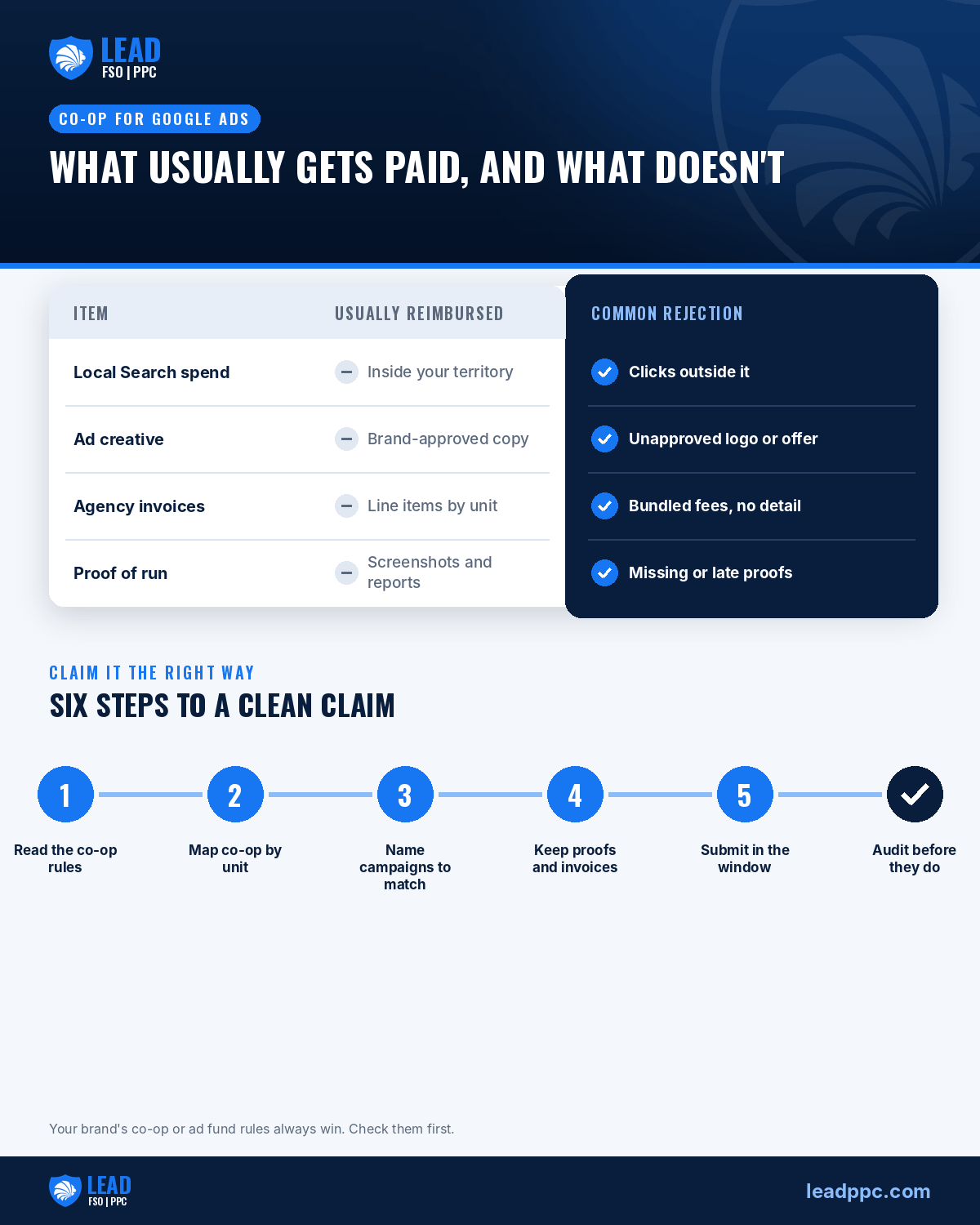
Co-op usually covers on-brand, in-territory media cost for approved local campaigns—and usually rejects off-brand creative, out-of-area targeting, franchise-sales keywords, and agency retainers unless the guide explicitly says otherwise.
Commonly eligible when the brand’s guide allows paid search:
- Google Ads media spend on approved campaign types (often Search; sometimes Local Services Ads or local/store-goals campaigns if listed).
- Spend tied to a specific unit or approved market with matching geo.
- Approved offers and brand messaging that follow the current creative standards.
Commonly rejected or disputed:
- Management fees, call-tracking subscriptions, creative production, or tooling buried inside a “media” invoice.
- Campaigns using outdated logos, wrong brand colors, unapproved claims, or competitor conquesting the guide forbids.
- Spend outside the unit’s territory or against national brand terms the fund already covers.
- Recruiting / “franchise opportunity” traffic mistaken for consumer demand.
Read the eligible-channel list every fund year. Some systems reimburse Search but not LSA; others reimburse only brand-templated campaigns run through a preferred platform. If Google Ads isn’t listed, get written clarification before you scale a claimable budget.
Creative, Logo, and Offer Rules That Kill Claims
Claims die when the live ad doesn’t match an approved template—even if performance was strong. Screenshot what ran, not what you meant to run.
Operator habits that survive audits:
- Use current brand assets only. Pull logos, lockups, and disclaimers from the brand portal for the active fund period. Retired marks are a frequent denial reason.
- Keep offers inside the approved set. If the co-op calendar lists three promos this quarter, don’t invent a fourth in the headline because it converts better.
- Match landing pages. Many programs require the click to land on a brand-site location page or an approved microsite. A high-converting agency page can still be non-reimbursable.
- Watch automated assets. If the brand forbids certain auto-generated headlines or URL expansions, disable them or document that they’re off. “Google wrote it” rarely wins a clawback appeal.
- Archive proofs. Save ad screenshots, asset-group exports, and landing-page captures with dates that overlap the invoice period.
If your agency builds RSA copy, give them the brand’s required phrases and banned terms in writing. Co-op compliance is part of the brief, not a finance chore after the month closes.
Receipt and Naming Conventions Agencies Must Follow
Reimbursement needs a paper trail that ties Google’s charge to a unit, a geo, and approved creative. Ambiguous invoices are why good spend never gets paid back.
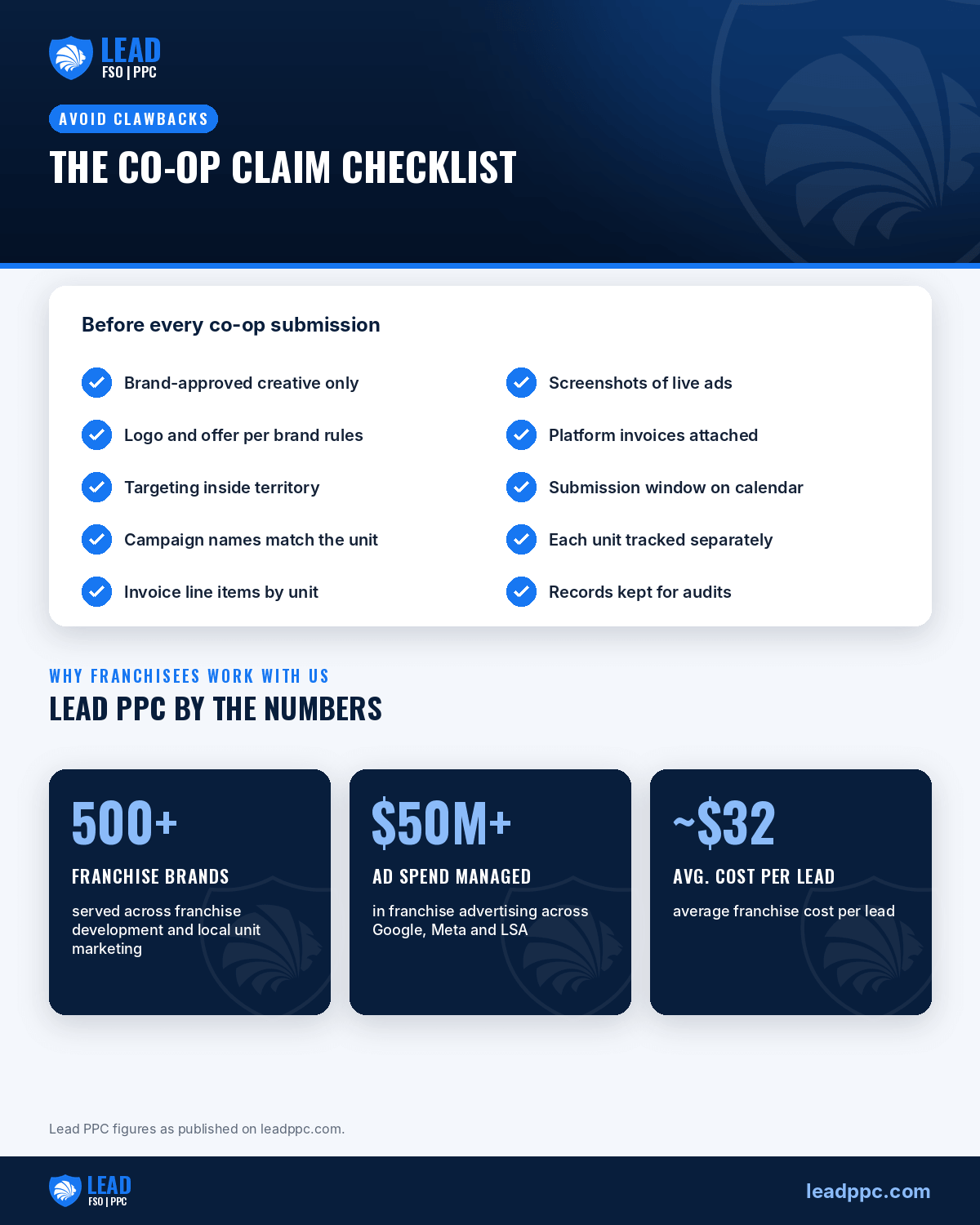
Ask your agency (or in-house buyer) to standardize:
| Artifact | What auditors want to see |
|---|---|
| Google invoice / billing export | Account ID, billing period, media cost separated from taxes; no blended “services” line pretending to be media |
| Campaign naming | Unit ID or store number, market, channel, and fund period (for example, U04 | North | Search | Co-Op Q3) |
| Geo report | Targeted locations and exclusions for the claim window; proof you weren’t buying a neighboring franchisee’s core ZIPs |
| Creative proof | Ads and landing pages as served, with approval IDs if the brand issues them |
| Agency invoice | Media pass-through vs. management fee on separate lines; reimbursable amount highlighted |
If you run multiple units in one account, reporting must still break spend by unit. Shared budgets and vague labels force corporate to guess—and guessing usually means denial. Align naming with the same unit IDs you use in call tracking so finance, ops, and the claim packet tell one story.
Splitting Co-Op Across Several Units You Own
Default to claiming per unit against that unit’s accrual or cap, and only pool across locations when the franchisor’s guide explicitly allows it. Multi-unit ownership does not automatically mean one combined wallet.
- Map accrual by unit. Know what each location earned or was allotted for the fund period before you move budget between them.
- Don’t rob a weak unit to feed a hero unit unless the rules allow transfers and you document the approval. Audits notice patterns where one store number’s co-op always pays for another store’s clicks.
- Watch entity boundaries. If units sit in different LLCs, reimbursement checks and W-9 details may need to match the entity that paid Google.
- Keep geo honest when units border each other. Pooling creative is fine; pooling territory without permission is how you create overlap claims and neighbor disputes. Use the same discipline as our territory overlap playbook.
When the brand allows a multi-unit operator agreement, get the pooling rules in writing—eligible markets, reporting format, and whether national exclusions still apply per pin.
When Corporate National Campaigns Collide With Your Local Spend
National brand campaigns and your local co-op campaigns can appear in the same ZIPs; your job is to add local coverage and measurable leads without breaking brand rules or bidding yourself into a mess.
Practical approaches operators use:
- Clarify the lane. Ask the brand which queries, offers, and geos national covers. Local co-op often wins on service + city terms, call extensions, and unit-level landing paths national can’t personalize.
- Don’t mirror national with a second near-identical RSA in the same auction unless the guide encourages supported local amplification. Duplicate messaging wastes budget and complicates attribution.
- Protect call attribution. National may send calls to a call center; your co-op campaigns should use unit-level tracking so you can prove local lead volume in the claim. See LSA operations if your brand treats LSA as a separate local channel.
- Escalate conflicts with data. If national always tops you on brand terms in your ZIPs, bring auction insights and call outcomes to the brand team—don’t “fix it” with banned competitor or trademark tactics.
Coexistence is normal in franchise systems. The claim-friendly move is documented local value, not silent auction wars.
Clawbacks and Audit Red Flags
Clawbacks happen when reimbursed spend later fails an audit—usually creative drift, geo drift, or invoices that can’t be tied to approved media. Build the file as if someone will ask for it six months later.
Red flags that trigger scrutiny:
- Ad copy or landing pages that changed after approval screenshots were submitted.
- Location targeting broader than the protected territory, or Presence or Interest settings that pulled substantial out-of-area traffic without explanation.
- One invoice covering multiple units with no allocation method.
- Agency fees labeled as media.
- Spend spikes in the last days of a fund period with thin proof of approvals.
- Claims for channels the current guide doesn’t list.
Also watch capacity. Pouring remaining co-op into a unit that can’t answer the phone creates refunds, bad reviews, and ugly lead quality—then someone asks why reimbursed spend produced nothing. Match budgets to closers using the same thinking as our lead capacity planning guide.
If you buy or sell a unit mid-fund-year, confirm who owns the remaining co-op balance and who holds the invoice history. The marketing handoff checklist is the right place to capture ad-account access and billing proofs before closing.
Frequently Asked Questions
Can Google Ads spend be reimbursed from the franchise advertising fund?
Often yes, when the brand’s co-op or NAF guide lists paid search (or specific Google products) as eligible and the campaigns follow creative, geo, and documentation rules. Eligibility is brand-specific—confirm in the current fund guide before you assume Search is covered.
What proof do you need for a co-op claim?
Typically the Google billing export or invoice for media cost, campaign naming that identifies the unit, geo settings for the period, creative and landing-page screenshots, and an agency invoice that separates media from fees. Submit inside the brand’s window with any required approval codes.
Can one multi-unit operator pool co-op across locations?
Only if the franchisor allows pooling in writing. Default practice is to claim against each unit’s own accrual or cap. Moving balances between stores without permission is a common audit problem.
What happens if corporate is already bidding in your ZIPs?
Local co-op campaigns can still run when the guide allows, usually as in-territory support with unit-level tracking and approved local messaging. Don’t fight national with off-brand copy; document the local lane and escalate overlap with data if brand terms crowd out local demand.
Are Local Services Ads reimbursable under co-op?
Only when the brand’s guide includes them. Some systems treat LSA like Search; others exclude it or require a preferred vendor. Get written confirmation before submitting LSA media as a claim.
Can agency management fees be submitted with media?
Usually not. Most programs reimburse media cost only. Keep fees on a separate invoice line so the reimbursable amount is obvious.
How do you avoid a clawback after reimbursement is paid?
Freeze proof at claim time, keep live ads aligned with what you submitted, maintain in-territory geo, and retain billing exports for the brand’s audit period. Change control on RSA assets matters as much as the original approval.
What if a unit’s co-op balance expires before you can spend it?
Start the claim calendar when the fund period opens, not in the last week. If capacity is the blocker, fix staffing or redistribute only through allowed transfers—don’t blast non-compliant campaigns just to clear a balance.
Need Help?
If you’re sitting on unused co-op or NAF funds and want help turning them into claimable Google Ads spend — creative compliance, receipt packets, multi-unit allocation, or coexistence with national campaigns — fill out our Contact Us form.
We can help you spend what’s reimbursable, document it the way auditors expect, and keep local campaigns working alongside the brand’s national presence.

Entrepreneur with a focus on Lead Generation, Google Adwords, Bing Ads, and Conversion.


Leave A Comment