
Pre-Opening Ads for a New Franchise Unit: The 60–90 Day Paid Media Checklist
Pre-opening ads for a new franchise unit: the 60-90 day paid media checklist.
Key Takeaways
- Start paid media work 60–90 days before open so Google Ads, Local Services Ads (where applicable), call tracking, landing pages, and the Google Business Profile are verified and testable before soft open—not on day one.
- Fence the new unit with Presence location targeting, ZIP or radius inclusions that match its territory, and exclusions that protect sister units. Give the new pin its own budget line so pre-open spend never hides inside a mature unit’s campaigns.
- Search is usually the first channel to go live; LSA needs verification lead time and a real service area; store-goals / Performance Max local campaigns need a verified Business Profile and only make sense once the location can actually receive visits or calls.
- Landing pages, tracking numbers, CRM dispositions, and GBP opening-date settings must be ready before spend. Soft-open creative sells “now booking / accepting appointments”; grand-open creative sells the event and the offer.
- Hand off into steady-state bidding only after you have clean conversion data, answered phones, and geo that doesn’t cannibalize neighboring units you already own.
- Treat pre-open as a dated checklist with owners on your ops team, your agency, and the franchisor—not a last-week scramble.
Opening unit #2, #5, or #12 is different from opening your first. You already have ads, sister units with conversion history, and a scoreboard that works. The new location wants that same machine on day one—and usually gets a campaign bolted onto an existing account, a pin that bleeds into a neighbor’s ZIPs, and a soft-open week where nobody knows which unit the phones are ringing for.
I’ve seen the pattern too many times: construction finishes late, the brand site page goes live late, and paid search gets turned on the Friday before soft open. This checklist is for multi-unit operators who control local spend and need Search, LSA, and store-goals campaigns live before day one without torching the new budget or confusing sister-unit geo.
It pairs with our multi-unit franchise advertising playbook for ongoing budgets and structure, and with our Google Ads account structure guide for whether the new unit becomes campaigns in an existing account or its own sub-account.
A note on rules: Google Ads, Local Services Ads, Business Profile, and franchise co-op rules change, and brand agreements vary. Confirm current product details in Google’s help center and your franchisor’s local marketing guide before you launch.
When to Turn Ads On Before the Unit Opens
Turn paid media on in stages 60–90 days before open, with verification and tracking first, limited Search next, and full budgets only when someone can answer and book. Day-one launch with untested numbers is how you burn the opening budget.
Work backward from soft open, not grand open. Soft open is when you can actually take appointments or sell; grand open is the marketing event. Your paid channels need to be ready for soft open.
| Window | What to finish |
|---|---|
| 90–60 days out | Confirm account structure and billing for the new unit; start LSA verification if the category qualifies; claim or create the Google Business Profile with a future opening date; order tracking numbers; draft landing page and call routing |
| 60–30 days out | Build Search campaigns with geo fences and sister-unit exclusions; finish call tracking and form routing tests; publish the pre-open landing page; post GBP construction and “opening soon” updates once the profile is eligible to show |
| 30–14 days out | Soft launch Search at a floor budget; confirm LSA service area and destination number; train whoever answers the phone; fix broken tracking before you scale |
| 14 days through soft open | Raise budgets only as answer rate and booking capacity allow; switch creative from “opening soon” to “now open / now booking”; keep grand-open event creative separate |
Google’s Business Profile help notes that after you set a future opening date and verify, the profile can show starting 90 days before that date, with posts, photos, and a description available in that window. Users typically can’t leave reviews until you’re officially open. Use GBP for awareness; don’t treat it as a substitute for paid Search when you need booked jobs on week one.
If your crews can’t handle more volume yet, hold the higher budgets. Our lead capacity planning guide is the filter: spend should never outrun the people who answer and close.
Geo and Budget Fences So the New Pin Doesn’t Steal From Sister Units
Give the new unit its own location targets, its own budget (or budget line), and explicit exclusions for ZIPs or radii that belong to neighboring units you own. Without those fences, Smart Bidding and broad match will happily buy the same searcher for two of your locations.
Three controls matter more than clever ad copy:
- Location inclusions: Target only the new unit’s contracted territory—ZIPs, cities, or a radius that matches how you actually dispatch or draw customers. Don’t “borrow” a sister unit’s strong ZIPs to warm up the new pin.
- Location exclusions: Exclude the core ZIPs of adjacent units you own. Mirror those exclusions on the sister units so they don’t keep bidding into the new territory either. Walk through the border cases with the same map you use in our territory overlap playbook.
- Presence targeting: For local service and storefront units, set advanced location options to Presence (people in or regularly in your targeted locations), not the default Presence or Interest. Presence or Interest will show ads to people outside the territory who merely searched a city name, which is how pre-open spend leaks into sister markets.
Budget fencing is as important as geo. Put the new unit on its own campaign budget (or its own sub-account). Do not fund it from a mature unit’s shared budget—mixed spend hides whether the new pin is learning or the old ones are slipping. Name it unmistakably (for example, U07 | East Metro | Search | Pre-Open) so finance can see the line without asking the agency.
Search vs LSA vs Local / Store-Goals Campaigns in Pre-Open
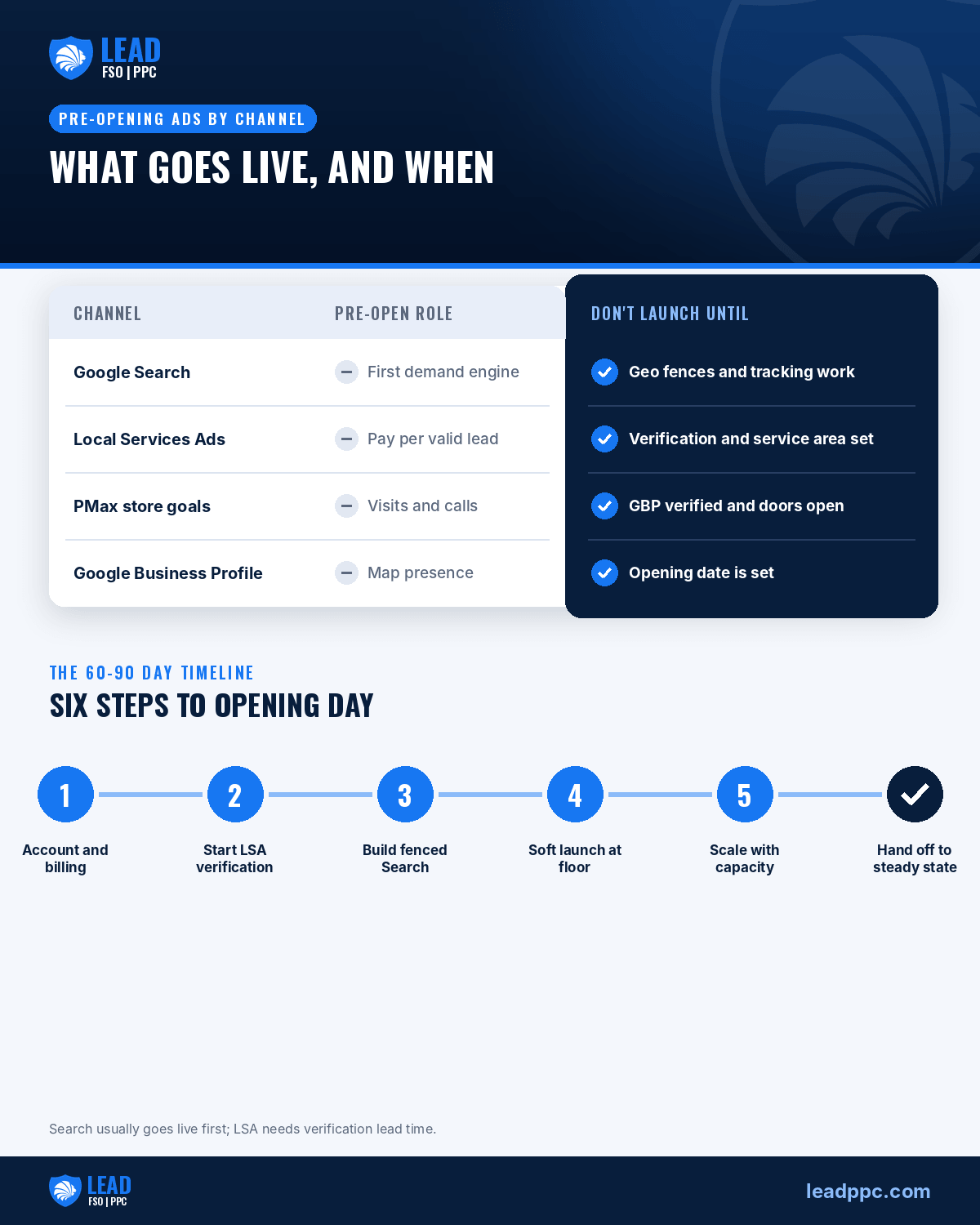
Use Search first for controllable demand, start LSA only when verification and a real service area are ready, and use Performance Max store-goals (the successor to classic Local campaigns) only when the location can receive visits, calls, or direction actions. Each channel has a different readiness bar.
| Channel | Pre-open role | Don’t launch until |
|---|---|---|
| Search (Google Ads) | Primary demand engine; keyword and geo control; best place to learn which queries convert for the new pin | Landing page live, tracking numbers tested, Presence geo set, sister-unit exclusions live |
| Local Services Ads | Pay-per-valid-lead demand in eligible categories; strong when you need booked-service intent | Screening/verification underway or complete, license/insurance in the right entity name, service area matches territory, destination phone answered |
| Performance Max for store goals | Promotes a verified location across Search, Maps, and related surfaces for visits, calls, or directions | Business Profile verified and linked, location actually able to receive customers or calls, assets and hours accurate |
Search. Build a lean non-brand structure first: core service themes, brand-plus-location if the franchisor allows, and a tight negative list (franchise opportunity terms, DIY, job seekers, cities you don’t serve). Keep brand-fund national terms out unless co-op rules require them. Bid conservatively until call and form quality is confirmed.
LSA. Local Services Ads charge for valid leads after a customer contacts you through the ad. Google screens businesses (licenses, insurance, and in many U.S. categories background checks), so start verification in the 90–60 day window. Set the service area to the new unit’s territory only, and route destination numbers to staff who know this unit’s hours. See our LSA operations guide.
Local / store-goals. Classic Local campaigns have been succeeded by Performance Max for store goals, which promote linked Business Profile locations toward store visits, store sales, or local actions such as calls and directions. They’re a poor fit for a dark site and a strong fit once the pin is staffed. Mobile/service-area models should prioritize Search and LSA over store-visit goals.
Landing Page, Call Tracking, and GBP Readiness Before Spend
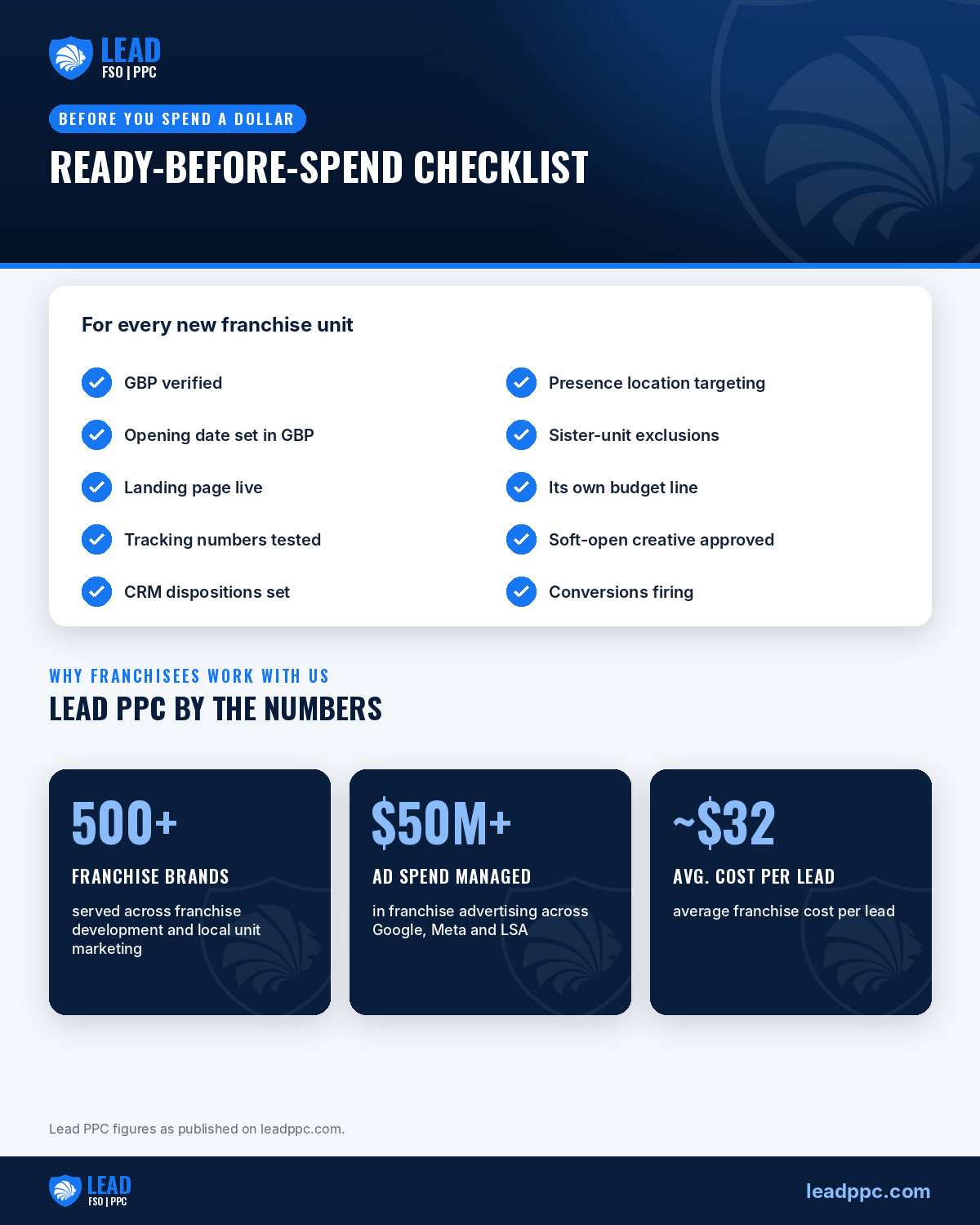
Do not buy clicks until the page, the numbers, and the listing all resolve to the new unit. Pre-open traffic that hits a sister unit’s page or a dead phone is paid confusion.
Landing page. Prefer a unit-specific URL or clearly labeled location page: service area, soft-open hours, what you can book now, and a form that routes to the new unit’s queue. If the franchisor owns the brand-site locator, get that page approved early; bridge landing pages still need brand-compliant creative and UTMs that name the unit.
Call tracking. Provision tracking numbers for the new unit inside the same stack you use across locations, with dispositions and unit IDs that match your scoreboard. Test-call every number that will appear in ads, LSA, GBP, and the landing page. Forwarding to a sister unit’s front desk is acceptable for a short staffing bridge only if calls are tagged to the new unit and someone knows which location the caller wants. Build it the way our multi-unit call tracking guide describes—one stack, not a one-off provider for the opening.
Google Business Profile. Create or claim the profile for the correct address, set the future opening date, verify early, and keep name/category/hours consistent with the brand site. Use posts and photos for construction progress and opening announcements in the pre-open window Google allows. Do not mark a not-yet-open unit as a duplicate of a sister location, and do not put the new unit’s ads on a sister unit’s profile.
Soft-Open vs Grand-Open Creative
Soft-open ads sell availability; grand-open ads sell the event. Keep them in separate ad groups or asset groups so you can kill the event copy without pausing demand.
- Soft open: “Now booking,” “Accepting appointments,” “Open for [service] in [area],” with clear hours and a friction-free call/form path. No countdown to a party the caller didn’t ask for.
- Grand open: Date, offer, RSVP or walk-in details, and a hard end date on the promotion. Pause or label these assets the day after the event so Smart Bidding doesn’t keep optimizing to an expired coupon.
- Offers: Only use franchisor-approved discounts. Co-op and brand teams reject non-approved creative faster than any other claim issue.
- Extensions / assets: Location, call, sitelinks to hours and directions, and structured snippets that match what you actually deliver on week one—not the full menu you’ll have in month three.
Hand-Off Into Steady-State Bidding
Move from pre-open to steady state when tracking is clean, phones are answered, geo fences are stable, and you have enough conversions for automated bidding to have something real to learn from—not on a fixed calendar date alone.
Practical hand-off steps:
- Rename or relabel campaigns from Pre-Open to the standard unit naming once soft open sticks.
- Shift from manual or maximized-clicks learning bids to your normal target CPA / target ROAS only after conversion definitions match sister units (qualified call, booked job, or whatever you actually optimize to).
- Compare the new unit to its own soft-open baseline and to similar units at the same age—not to your best mature location.
- Revisit border ZIPs after 2–4 weeks of live data; auction insights and call reports will show whether fences need tightening.
- For resale units, fold inherited accounts with the 30-day marketing handoff checklist so access and billing don’t stay on the seller’s cards.
Steady state still needs a weekly scoreboard row: spend, qualified calls, answer rate, booked jobs, cost per booked job. Pre-open is over when that row is trustworthy, not when the ribbon is cut.
Frequently Asked Questions
How many days before opening should Google Ads go live?
Plan the build 60–90 days out, and put limited Search budget live roughly 14–30 days before soft open once tracking, landing pages, and geo fences are tested. Full budgets belong after someone can answer and book—not on the morning of grand opening.
Should the new unit share the existing Google Ads account?
It can, as tightly named campaigns with its own budget and geo, when one entity pays for a small cluster in one metro. Use a separate sub-account under your manager account when billing entities differ, units change hands, or you need cleaner separation. Decide before launch using the same criteria as our account structure guide.
How do you keep pre-open spend from counting against mature units?
Give the new unit its own campaign budget or sub-account, its own conversion labels, and reporting names that isolate the unit ID. Never fund pre-open by raising a shared budget on a sister unit’s campaigns.
What call-tracking setup do you need before the soft open?
Unit-specific tracking numbers in your multi-unit stack, test-called end to end, with CRM or disposition fields that tag the new location. LSA destination numbers and GBP phone fields should match the same routing plan, even if the public number differs from the ad-tracking number.
Can you run Local Services Ads before the location is open?
Only when verification requirements are met and you can actually take and fulfill the work in the service area you set. Start screening early; don’t set a live LSA service area for a unit that can’t answer or serve yet.
Should pre-open campaigns use Presence or Presence or Interest?
For local franchise units protecting sister territories, use Presence so ads focus on people in or regularly in the targeted area. Presence or Interest is more likely to pull clicks from outside the fence based on city-name searches.
When should Performance Max store-goals campaigns start?
After the Business Profile is verified, linked, and the location can receive visits or calls. They’re a poor first channel for a dark site and a better complement once Search (and LSA, if applicable) already have clean tracking.
What if sister units already bid in the new unit’s ZIPs?
Reassign those ZIPs with inclusions and exclusions on both sides before the new campaigns ramp. Leaving overlap “for a few weeks” usually means you pay twice for the same households.
Need Help?
If you’re opening another franchise unit and want a second set of eyes on the 60–90 day paid media checklist — geo fences, Search vs LSA timing, call tracking, or hand-off into steady-state bidding — fill out our Contact Us form.
We can help you launch the new pin without stealing demand from the units you already run, and get reporting clean before soft open—not after.

Entrepreneur with a focus on Lead Generation, Google Adwords, Bing Ads, and Conversion.
Leave A Comment