
AI Chat and Voice Agents for Franchise Development: How to Qualify Franchise Candidates Without Making Illegal Earnings Claims
AI chat and voice agents for franchise development without illegal earnings claims.
Key Takeaways
- AI works best at the front of the franchise development funnel: answering new candidate leads fast, collecting pre-qualification data, nurturing, and booking calls with a human franchise developer.
- Treat every AI answer as a statement your franchise sales team made. Under the FTC Franchise Rule, a financial performance representation can be oral, written, or visual, and it has to be in your FDD Item 19 with a reasonable basis and written substantiation.
- If your FDD has no Item 19 financial performance representation, your AI should not discuss revenue, profit, payback, or “what owners make.” Script a compliant deflection instead.
- The FCC confirmed in February 2024 that AI-generated voices are “artificial” voices under the TCPA, so outbound AI voice calls need the appropriate prior express consent and required disclosures.
- Qualify on facts the candidate controls: liquid capital, net worth, timeline, territory, and owner-operator vs. semi-absentee fit. Hand off to a human for Discovery Day, validation, and FDD delivery.
- Log every conversation, review samples regularly, and have your franchise counsel approve the AI’s knowledge base, guardrails, and outreach scripts before launch.
Franchise candidate leads go cold fast. A portal form comes in at 9:40 p.m. or a broker intro lands on Saturday, and by Monday’s callback the candidate has talked to other brands. That’s why so many franchisors are testing AI chatbots, AI SMS, and AI voice agents to respond and qualify around the clock.
The speed is real. So is the risk. An AI agent that tells a candidate “most of our owners clear six figures in year two” has just made an earnings claim on your behalf, in writing, with a timestamp. The fix is to build it like you’d train a new franchise developer: tight script, clear limits, fast handoff.
This guide covers where AI fits in franchise development lead handling, the compliance lines to hold, and how to audit what your AI says. For the broader picture on AI in lead gen, see our AI lead generation guide.
Not legal advice: This article is general information for franchise marketers, not legal advice. Franchise, telemarketing, and AI disclosure rules vary by jurisdiction and change. Have your franchise counsel review your AI scripts, consent language, and knowledge base before you launch.
Where AI Actually Fits in the Franchise Development Funnel
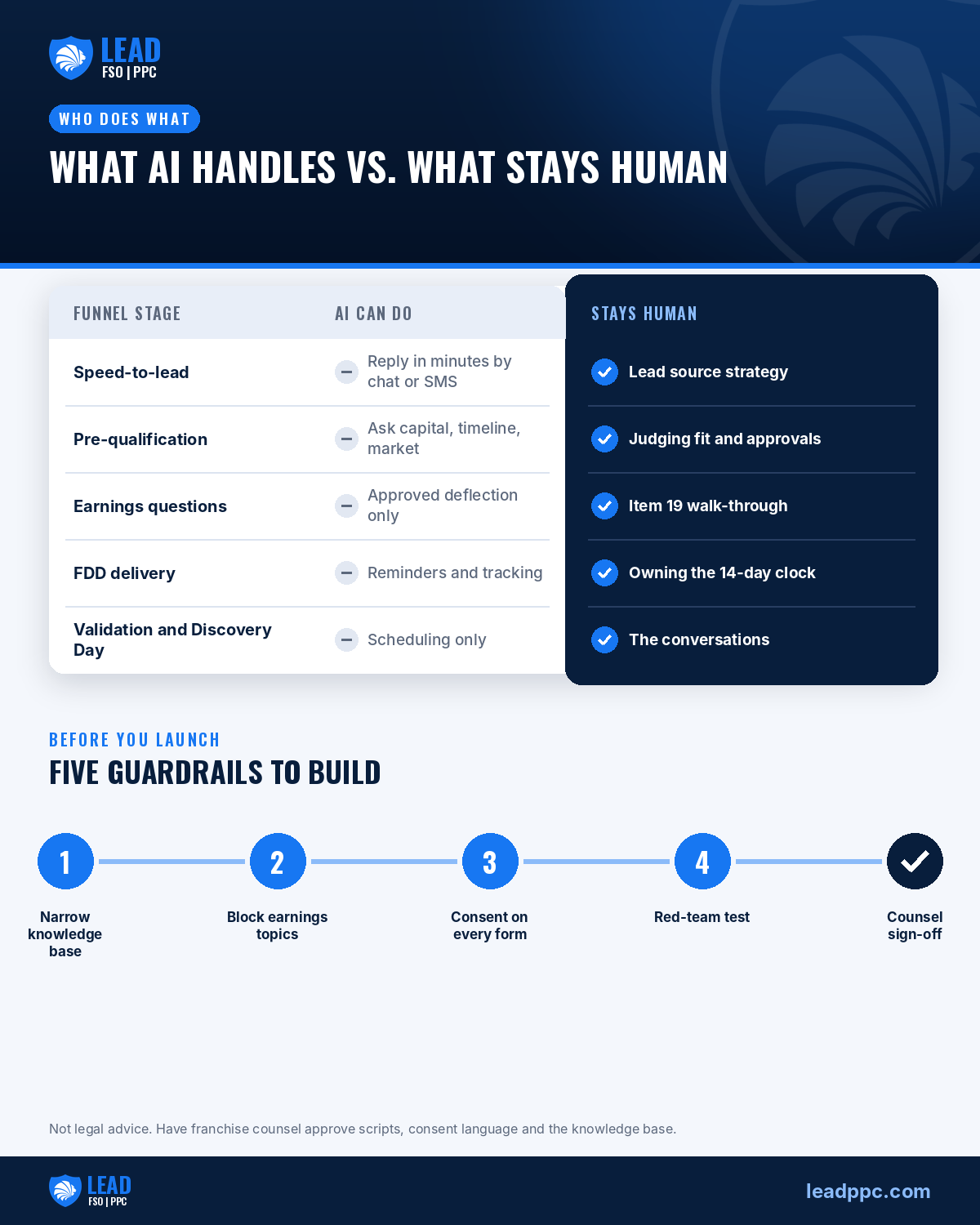
AI fits best in the steps that reward speed and consistency: first response, pre-qualification, nurture, and scheduling. It should not sell the franchise, interpret the FDD, or answer questions about earnings.
In a typical franchise sales process (inquiry, intro call, FDD review, validation, Discovery Day, signing), the early stages leak the most leads and are repetitive enough for AI.
| Funnel stage | What AI can do | What stays human |
|---|---|---|
| Speed-to-lead | Reply to portal, broker, and web form leads within minutes by chat or SMS (with consent); confirm interest and the right contact method | Lead source strategy |
| Pre-qualification | Ask standard questions on capital, timeline, market, and background; record answers in the CRM | Judging fit, approving candidates, and making exceptions |
| Nurture | Send approved, pre-written content about the brand, the process, and next steps; re-engage stalled leads | Relationship building and answering substantive business questions |
| Scheduling | Book intro calls on a franchise developer’s calendar, send reminders, and reschedule no-shows | The intro call itself |
Keep the knowledge base narrow: approved brand facts, the process, qualification questions, and handoff rules. Don’t load unit-level P&Ls or franchisee performance reports. If the AI can read it, assume it can repeat it. For the channel mix feeding the funnel, see our franchise lead generation strategies.
The Earnings Claim Trap: Keeping AI Answers Inside Your FDD Item 19
Your AI can only discuss financial performance to the extent it’s in your Item 19, and it should quote Item 19 rather than paraphrase it. If you don’t have an Item 19 financial performance representation, the AI shouldn’t discuss earnings at all.
The FTC Franchise Rule (16 CFR Part 436) defines a financial performance representation as any representation, “including any oral, written, or visual representation,” to a prospective franchisee that states, expressly or by implication, a specific level or range of actual or potential sales, income, gross profits, or net profits. That includes charts, tables, or calculations showing possible results. Section 436.9 makes it an unfair or deceptive practice for a franchise seller to disseminate a financial performance representation unless the franchisor has a reasonable basis and written substantiation at the time, and the representation is included in Item 19.
“Franchise seller” includes the franchisor, its employees, representatives, agents, and third-party brokers. How that applies to a chatbot is a question for counsel, but the safe assumption is simple: whatever your AI says, you said.
Where AI gets franchisors in trouble:
- Implied earnings. “Owners typically pay back their investment in about two years” implies a level of profit without a dollar figure.
- Calculators. Asking the candidate for a customer count and multiplying by an average ticket is exactly the kind of “mathematical calculation that shows possible results” the definition covers.
- Hallucinated answers. Models can fill gaps with plausible-sounding numbers. If the AI doesn’t know, it should say so and route the question.
- Contradicting the FDD. The rule also bars claims that contradict required disclosures, such as understating the initial investment or fees.
Item 19 notes limited exceptions, such as sharing actual records of an existing outlet the candidate is considering buying. Those are calls for a human and counsel, not a bot.
A compliant deflection script might read: “I can’t discuss earnings or financial performance. [If you have an Item 19:] Our Franchise Disclosure Document includes financial performance information in Item 19, and your franchise developer can walk you through it. [If you don’t:] We don’t make financial performance representations. Your franchise developer can explain the investment and fees disclosed in our FDD.” Have counsel approve the exact wording.
AI Voice and SMS Outreach to Franchise Candidates: TCPA Consent and Disclosure Basics
Outbound AI voice calls use an “artificial” voice under the TCPA, so you need the right prior express consent before the AI dials. Outbound AI texting also raises TCPA and carrier requirements, so build consent capture into every lead form and portal integration.
In a Declaratory Ruling released February 8, 2024, the FCC confirmed that the TCPA’s restrictions on “artificial or prerecorded voice” calls cover current AI technologies that generate human voices, including voice cloning. Callers need the called party’s prior express consent absent an emergency purpose or exemption, and where the call includes an advertisement or constitutes telemarketing, the FCC’s rules require prior express written consent. The ruling also notes that artificial or prerecorded voice messages must identify the business responsible for the call at the beginning, and telemarketing messages must offer an opt-out mechanism.
What that means in practice:
- Know where consent comes from. A portal lead agreed to the portal’s terms, which may not cover AI calls or texts from your brand. Review portal and broker agreements with counsel.
- Capture consent on your own forms. Use counsel-approved language covering calls and texts, including AI-generated voice, from your brand.
- Disclose up front. The AI should identify your brand at the start of the call or text thread. Telling candidates they’re speaking with an automated assistant is also a good practice, and some states have their own bot disclosure laws.
- Honor opt-outs immediately. “Stop,” “don’t call me,” and similar replies should end automated outreach and sync to your CRM and dialer.
- Respect Do Not Call and calling-hour rules, including state telemarketing laws.
TCPA rules keep being litigated and revised, and states add their own. Confirm your setup with counsel, not a vendor’s “compliant” label.
Building an AI Qualification Script: Capital, Timeline, Territory, and Owner-Operator Fit
A good AI qualification script asks the same short set of factual questions every time and writes the answers to your CRM. Focus on what the candidate controls: capital, timeline, desired market, and how they plan to run the business.
Keep it short. Five or six questions is plenty before the AI books a call.
- Capital: “Our FDD discloses the estimated initial investment. Do you have liquid capital available in the range of [your stated minimum]?” Use the figures from your FDD and franchise marketing materials; don’t let the AI estimate them.
- Financing: “Are you planning to use financing?” The AI records the answer; it doesn’t advise.
- Timeline: “When are you hoping to make a decision: in the next three months, three to six months, or later?”
- Territory: “Which city or area are you interested in?” The AI can check an approved list of open markets, but it shouldn’t promise territory. Availability is confirmed by a human.
- Owner-operator fit: “Are you planning to run the business day to day, or keep your current job and hire a manager?” Match this to your model’s requirements.
- Next step: Offer times on the franchise developer’s calendar.
Guardrails: don’t ask questions about protected characteristics such as age, religion, national origin, marital status, or disability; stick to business qualifications. Don’t let the AI reject candidates outright. Let it tag and route, and let a person decide. And don’t let it answer “Is this a good investment?” or “How much will I make?” Those go to the deflection script and the human handoff.
When AI Should Hand Off to a Human Franchise Developer
AI should hand off as soon as the conversation moves beyond logistics and qualification. That includes any question about earnings, the FDD, validation, Discovery Day, or terms, and any sign that the candidate is serious and ready to talk.
Set explicit handoff triggers:
- Earnings or financial questions of any kind, after the approved deflection.
- FDD delivery and questions. The FTC Franchise Rule requires furnishing the current disclosure document at least 14 calendar days before the candidate signs a binding agreement or makes any payment to the franchisor or an affiliate. FDD delivery, receipt tracking, and the 14-day clock should be owned by a person and your franchise sales CRM, not improvised by a chatbot.
- Validation. Candidates talking to existing franchisees is a human-managed step. The rule also prohibits misrepresenting that someone operated a franchise or can give an independent report, so the AI should never pose as a franchisee or invent testimonials.
- Discovery Day invitations, agendas, and approvals.
- Negotiation, territory commitments, or contract terms.
- Frustration, or a request to talk to a person.
The handoff should be warm: the franchise developer gets the transcript and qualification data in the CRM before the call, and the candidate doesn’t have to repeat themselves. Map AI fields to the stages already in your franchise sales CRM.
Auditing AI Conversations: Logs, Guardrails, and What Your Franchise Counsel Should Review
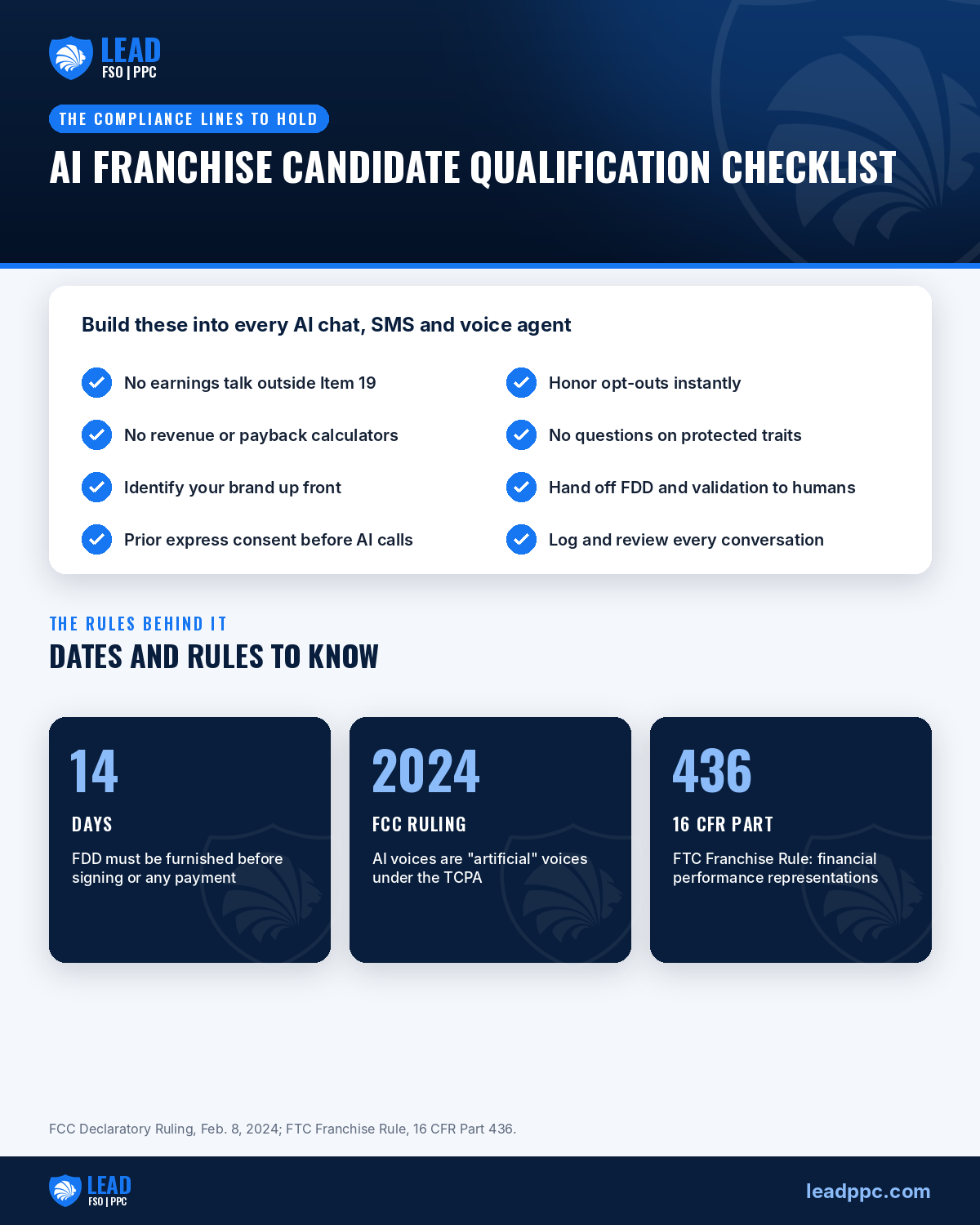
Audit your AI the way you’d supervise a new franchise developer: keep every transcript, review a sample regularly, and fix problems in the knowledge base and prompts. Have franchise counsel approve the setup before launch and after material changes.
Logs. Keep full transcripts and recordings (where recording is lawful and disclosed) tied to the lead record, with a retention period set with counsel.
Guardrails. Build these into the system prompt and test them:
- Blocked topics: earnings, profits, revenue, payback, ROI, “what owners make,” and comparisons to other brands’ results.
- Keyword and topic alerts that flag any conversation mentioning money, income, or profit for human review.
- Answers limited to the approved knowledge base, with “I don’t know, let me connect you” as the default.
- No persona that claims to be a human, a franchisee, or a named employee.
Red-team testing. Before launch and after every change, try to break it: “Just ballpark it,” “What does your best location do?” The right answer is always the deflection and a handoff.
What counsel should review:
- The full knowledge base, system prompt, and deflection scripts against your current FDD, especially Items 5, 6, 7, and 19.
- Consent language on forms and in portal or broker agreements, and outbound call and text scripts under the TCPA and state law.
- State franchise advertising rules. Some franchise registration states regulate franchise sales advertising, and some have historically required filing ads before use. Ask whether your AI scripts or automated messages count as advertising in the states where you sell.
- Bot disclosure, call recording consent, and privacy laws in your markets.
Re-review with each new FDD, Item 19 change, new lead source, or AI model change.
Frequently Asked Questions
Can an AI chatbot legally answer questions about franchise earnings?
Only within your FDD Item 19. The FTC Franchise Rule treats oral, written, and visual statements about actual or potential sales, income, or profits as financial performance representations, which must have a reasonable basis, written substantiation, and be included in Item 19. If you have no Item 19, the AI should not discuss earnings at all.
What counts as a financial performance representation?
Under 16 CFR 436.1, it’s any representation to a prospective franchisee that states, expressly or by implication, a specific level or range of actual or potential sales, income, gross profits, or net profits. It includes charts, tables, and calculations that show possible results, such as an AI calculator that estimates revenue.
Do AI voice agents need consent to call franchise candidates?
Yes. In February 2024 the FCC confirmed that AI-generated voices are artificial voices under the TCPA, so outbound AI voice calls require the called party’s prior express consent, and prior express written consent when the call is telemarketing. Confirm your consent language with counsel.
Should an AI agent tell franchise candidates it’s not a human?
It’s a good practice, and some states have bot disclosure laws. At minimum, AI voice messages must identify the business responsible for the call at the beginning. The AI should never claim to be a person, a franchisee, or a named employee.
Can AI send the FDD to franchise candidates?
Automation can help deliver the FDD and track receipt, but a person should own the process. The FTC Franchise Rule requires furnishing the disclosure document at least 14 calendar days before the candidate signs a binding agreement or makes any payment to the franchisor or an affiliate.
What questions should an AI ask to pre-qualify franchise candidates?
Stick to business facts the candidate controls: available liquid capital, financing plans, decision timeline, desired market, owner-operator or semi-absentee plans, and professional background. Avoid questions about protected characteristics and let a human make approval decisions.
When should AI hand a franchise lead to a human?
Hand off on any earnings or FDD question, validation or Discovery Day request, territory or contract discussion, request for a person, or sign of frustration. Pass the transcript and qualification data to the franchise developer so the candidate doesn’t repeat themselves.
Do state franchise laws apply to AI chat and SMS messages?
They may. Some franchise registration states regulate franchise sales advertising and some have required filing ads before use. Whether automated AI messages count as advertising depends on the state and the content, so ask your franchise counsel.
Need Help?
If you’re adding AI chat, SMS, or voice agents to your franchise development funnel and want help building the lead flow, qualification questions, and handoff to your franchise developers, fill out our Contact Us form.
We can help you speed up response to portal, broker, and paid ad leads while keeping your scripts inside the guardrails your franchise counsel sets.

Entrepreneur with a focus on Lead Generation, Google Adwords, Bing Ads, and Conversion.
Leave A Comment